
A Core Cognitive Framework for High Acuity, Low Occurrence Events
Introduction
HALO events (High Acuity, Low Occurrence emergencies) represent the most demanding moments in Emergency Medicine. HALO procedures are rare, time-critical, and unforgiving. They are rare, time-critical and performed on patients in extremis. They demand immediate decision-making, coordinated team performance, and precise technical execution under stress.
Although technically complex, failure in HALO events is rarely due to ignorance of anatomy or lack of procedural knowledge. It is frequently due to delay, hesitation, and system friction.
Training for HALO must therefore extend beyond technical skill acquisition. The educational framework described in Training for HALO Procedures (St Emlyn’s blog by Simon Carley) makes clear that optimal performance requires preparation in three domains:
- Psychomotor skill
- Personal cognitive preparation
- Team preparation
The HALO mindset integrates all three.
Learning Objectives
By the end of this chapter, the candidate should be able to:
- Define the HALO mindset
- Recognise Emergency Department–specific risks
- Understand why traditional training alone is insufficient
- Apply the HALO cognitive framework in real-time
- Integrate anticipation, recognition, decisiveness, and execution
What Is HALO?
High Acuity – Low Occurrence
HALO events are:
- Life-threatening
- Time-critical
- Rarely encountered
- Associated with high consequence of delay
Examples in Emergency Medicine include:
- Emergency surgical airway
- Lateral canthotomy
- Resuscitative thoracotomy
- Perimortem caesarean section
- Massive haemorrhage with physiological collapse
The defining feature is not technical complexity — it is rarity under time pressure.
The Frequency–Importance Mismatch
HALO procedures suffer from a structural mismatch due to:
- Rare events
- High stakes
- Low rehearsal
Common tasks improve through repetition. HALO tasks decay due to lack of it. Experience alone does not guarantee performance. Preparation does.
ED-Specific Risks in HALO Events
The Emergency Department amplifies HALO risk due to environmental and cognitive pressures.
1. Cognitive Risks
- Undifferentiated patients– The patients present with differing symptoms which may not be attributable to a single body system
- Tunnel vision and multitasking– Fixing one problem can lead to loss of awareness of surroundings and other physiological problems the patient may be encountering. Similarly, multi-tasking can lead to overlooking rapidly changing physiology.
- Diagnostic momentum– (a diagnosis once labeled by one provider becomes set in stone, leading subsequent clinicians to accept it without question). Patients may present with multiple pathology. Diagnosing or detecting one may lead to anchoring bias (relying too heavily on initial information or a first impression, failing to adjust to new data), and missing other pathologies
Impact:
Delayed declaration, omission of parallel actions, late definitive intervention.
2. Time & Pressure Risks
No warning deterioration, rapid collapse and no opportunity for controlled preparation due to rapidly changing physiology.
Impact:
Rushed decisions and missed anticipation window.
3. Team & Human Factors
- Ad hoc teams- some team members may have rarely worked with each other eg. Temporary/locum team members
- Variable experience- even among permanent team members, there is wide variating in experience and training
- Unclear leadership early- the senior most team member may not necessarily be the most suitable and trained to carry out the procedure.
Impact:
Delayed role allocation and communication failure.
4. System & Environment
- Rare procedure exposure- most of the
- Equipment friction
- Noise and crowding
Decision Algorithms
Algorithm: Universal HALO Decision Flow
Patient deteriorating?

        ↓

ANTICIPATE: "What could kill this patient next?"

        ↓

RECOGNISE: Red flags / physiology pattern

        ↓

DECLARE: "This is a HALO situation"

        ↓

PREPARE: Equipment + roles + escalation

        ↓

ACT: Decisive intervention

        ↓

EXECUTE
Inflection Point: Declaration.
Most HALO failures occur before declaration.
Impact:
Cognitive bandwidth consumed by searching rather than deciding.
Why HALO Fails
Failure typically occurs at the decision inflection point, not during the technical act.
Common patterns include:
- Waiting for diagnostic certainty
- Delayed escalation
- Hesitation to declare
- Underestimation of deterioration
- Fragmented team structure
HALO failure is cognitive before it is technical.
The HALO Mindset Defined
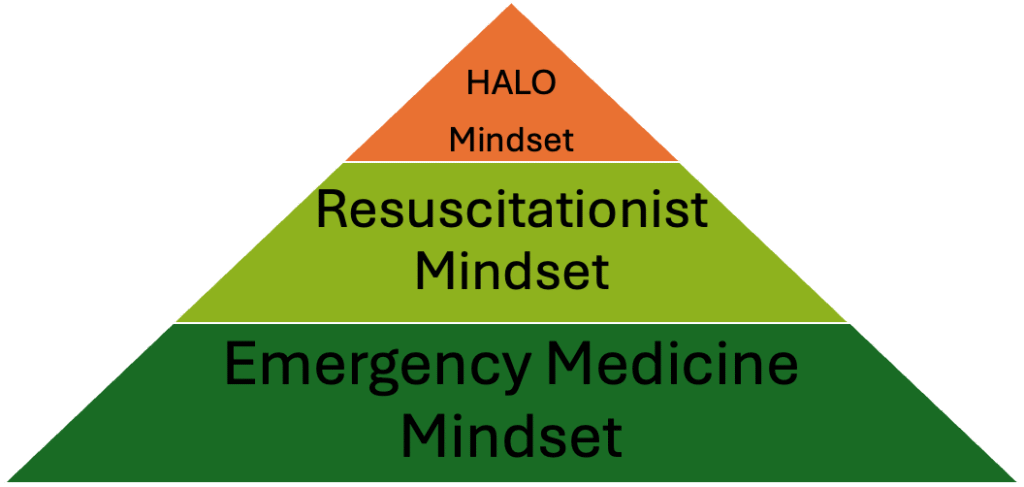
The HALO mindset sits at the top in the hierarchy pyramid, above the EM mindset and the Resuscitationist mindset. It is a structured cognitive framework that drives thinking and decision making under stress in high-pressure situations. It comprises of:
A – Anticipation R – Recognition D – Decisiveness E – Execution
This framework converts unpredictable deterioration into controlled escalation.
Anticipation
Ask early: “What could kill this patient next?”. Anticipation means:
- Identifying patients at risk before collapse
- Preparing equipment before crisis
- Involving senior/colleague/specialty support early
Anticipation buys time. Time reduces stress. Reduced stress improves performance.
Recognition
Recognition of deterioration in HALO procedures is physiology-driven, not diagnosis-driven.
In HALO events:
- Patterns matter more than labels
- Shock states matter more than confirmed diagnoses
- Deterioration trends matter more than static observations
Early recognition shortens the pathway to action.
Decisiveness
HALO events require action under incomplete information. Delayed correct action is often more harmful than early imperfect action. Decisiveness includes:
- Early declaration
- Trigger-based escalation
- Acceptance of uncertainty
Hesitation is the true enemy in HALO.
IFTT principle – If This Then That
Define thresholds in advance. Pre-defined triggers reduce debate at the inflection point.
Examples:
- If oxygenation fails despite optimal airway management
Then perform surgical airway - If third-trimester pregnancy with cardiac arrest
Then perform resuscitative hysterotomy
Execution
Execution is the visible component — but it is the final step. Execution fails when anticipation and declaration fail. Effective execution requires:
- Pre-allocated roles
- Clear leadership- Leadership reduces cognitive load across the team
- Closed-loop communication
- Simplified decision pathways
- Early verbalisation of risk
The Triumvirate of HALO Training
Effective preparation requires three domains:
1. Psychomotor Skills
Task training and procedural familiarity reduces personal cognitive load.
2. Cognitive Skills
Preparation, focus, decision thresholds
3. Team Skills
Support, communication, coordination
High-fidelity courses enhance realism (not reality), optimise technique, and increase familiarity — freeing cognitive bandwidth when needed.
Mental Rehearsal and Simulation
Your most powerful simulator is your mind
Regular mental rehearsal:
- Improves cognitive fluency
- Reduces hesitation
- Enhances confidence
Deliberate mental practice builds readiness.
3. Team Preparation
HALO success requires team readiness
Leader declares HALO
↓
Explicit role allocation
↓
Closed-loop communication
↓
Scene control
↓
Procedural execution
Mental Rehearsal as a Team
Discuss:
- Who stands where
- Who prepares kit
- Who controls scene
- What complications may occur
Key principles:
- Shared mental models
- Pre-briefs and declaration of intent
- Stop–start simulation (Rapid Cycle Deliberate Practice)
- Structured debrief
Without team preparation, even expert operators are vulnerable.
The HALO Countermeasure Model
Each ED-specific risk has a HALO response:
| ED Risk | HALO Countermeasure |
| Cognitive overload | Physiology-first thinking |
| Time pressure | Early anticipation and declaration |
| Team variability | Clear leadership and role allocation |
| System friction | Standardised kits and simulation |
Risk is predictable. Failure is preventable.
Professional Responsibility
HALO readiness is not optional expertise. It is a professional obligation.
Every Emergency clinician must:
- Train deliberately for rarity
- Declare early
- Lead clearly
- Act decisively
Key Take-Home Messages
- HALO events are predictable in nature, not timing
- Failure is usually delay, not ignorance
- Preparation beats experience
- Mindset matters as much as skill
- Train for rarity
- HALO readiness is a professional responsibility
Reflection
What is your personal decision threshold?
When will you declare HALO?
The mindset must be defined before the emergency begins.
Resources:
- High Performance Teams In Critical Care From CODA CHANGE
- Training for HALO procedures. Parts 1,2,3 in St. Emlyn’s blog
- EMCrit RACC Podcast
- First10EM